

.png)
TL;DR
This article will act as my personal philosophy on AEO. It will highlight my approach and the tactics I've been seen work across all my B2B SaaS clients. For anyone interested in services with me, this article will explain what our process looks like
I’m sure you’re as tired as I am of hearing the constant blabber about every “new” AEO tactic.
Chunking, firing your marketing team to replace them with agents, llms.txt.
It’s absolutely everywhere, and you can’t escape it.
The worst part is that each side of the aisle’s tactics directly contradict one another.
Well, I’m hoping this article helps to fix that.
I’ve been working closely with my clients on AI search over the past few years, measuring and testing the tactics most effective for LLM visibility.
It’s led to my clients driving over $1M+ from AI search and being mentioned for over 50% of their money prompts.
This article will be a complete roadmap of my team's approach to AEO and a roundup of the tactics I’ve seen work firsthand across a wide range of B2B SaaS verticals.
NOTE: This article is entirely based on my personal approach, developed through countless tests and experiments for my clients. While this approach works for me, it is not guaranteed to be replicable, and you should still be ready (and willing) to experiment yourself to really understand what will work for you.
We view AEO through one major lens
The core of AEO boils down to this: Brand context is everything, and that needs to be clear on your site (SEO) and across the web (PR).
You can see a perfect visualization of this below, courtesy of Olaf Kopp.
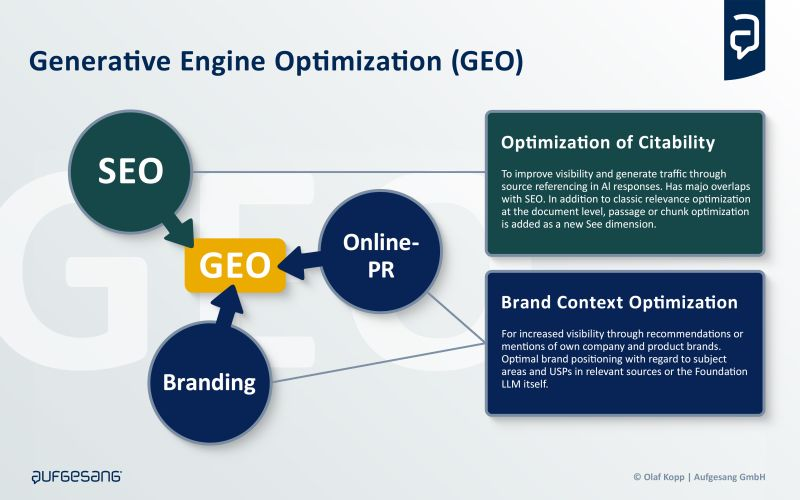
At its core, the strategic layer of AEO centers on branding, while the executional layers largely fall under SEO and PR.
Gaetano Di Nardi, a well-known growth advisor, frames it as a CMO initiative rather than an SEO one:
GEO is a strategic problem at the executive level more than it is an SEO problem at the operational level. The biggest GEO upside doesn’t come from technical optimization – but rather, the coordination of brand positioning, messaging, and reputation management across on-site and off-site channels. Everyone assumes the SEO team should be 100% responsible for all aspects of GEO, meanwhile they only control a limited portion of how LLMs form their opinion of a brand.
He further adds:
The core GEO problem to solve is whether LLMs believe your brand belongs in the answer or not. LLMs need to arrive at a consensus about your brand which is shaped by reputation, category alignment, and repeated confirmation across the web. Technical SEO provides the base layer foundation, but it does not help LLMs form a conclusion about your brand’s positioning in the market. The bigger opportunity is to align messaging across every surface that influences how LLMs interpret your brand and why it deserves to be recommended. That means GEO is not a siloed optimization problem, but rather an ecosystem visibility problem.
I’ve seen firsthand just how true this is, working across a wide range of B2B SaaS verticals.
The reason why AEO is much larger than a single SEO can handle is that the fundamentals of your company’s marketing determine whether it even has a shot at AI search.
This means you have to meet qualifications such as:
So for AEO to actually work, the LLM has to do more than understand what you do. It has to see you as the most relevant and recognizable option for your ICP.
Vague positioning gives it nothing to work with, so unless you're ClickUp or Asana, calling yourself a "project management tool" is going to get you nowhere.
The riches are in the niches, and that's especially true for AI search.
If you position yourself as a "project management tool for neurodivergents," you build mental availability with your core buyers, which makes it way easier for an LLM to land on you as the most relevant option in that category.
Plus, you’ll have fewer competitors to go up against as well.
A few brands that own their niche and thus are the default LLM recommendation for that category:
- SparkToro: Audience research tool for B2B
- Wynter: Message testing for B2B
- Clay: GTM data enrichment for outbound teams
- Attio: CRM for GTM teams
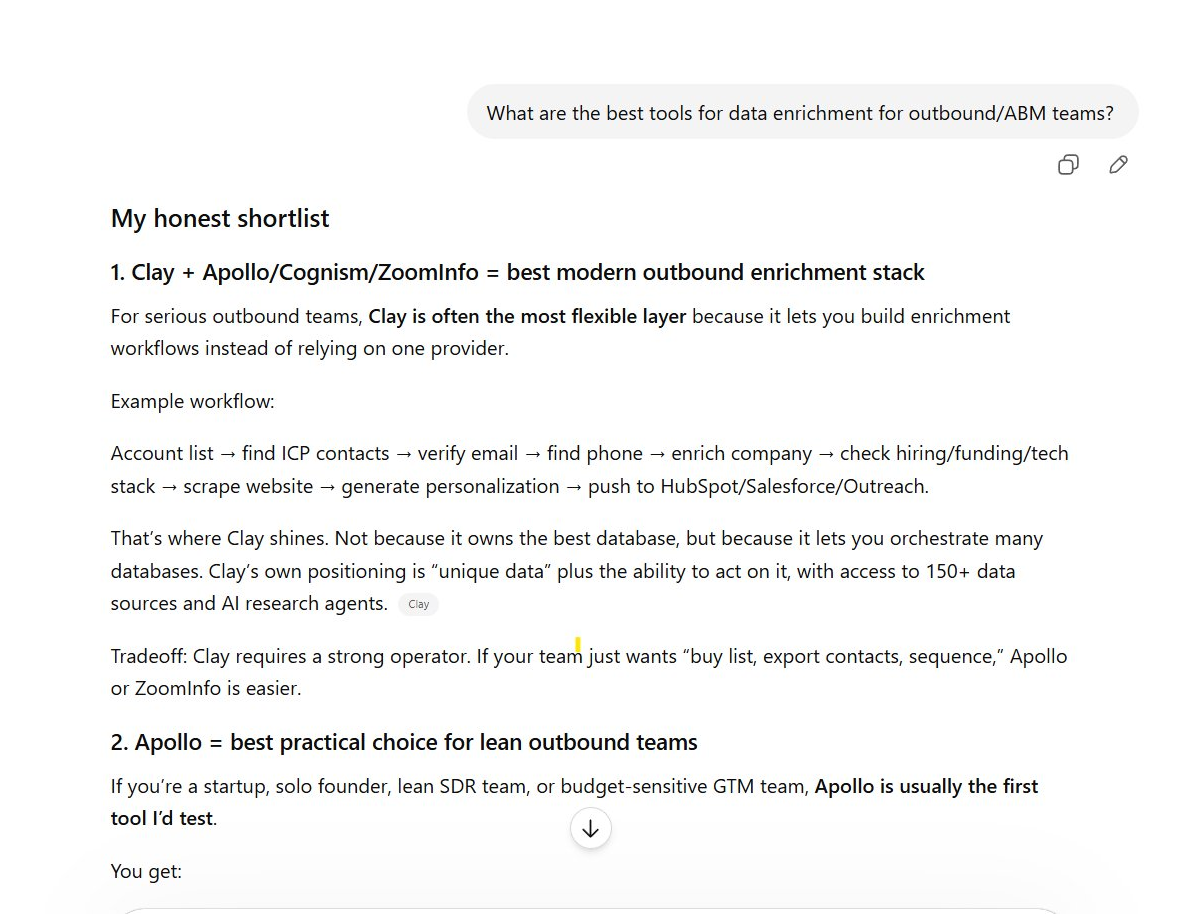
AI search will be a struggle if your brand isn’t clearly positioned and differentiated.
And that’s just the entry ticket to AEO.
Actual AEO is where I come in.
Here’s how we prioritize AEO during each engagement
The goal of each engagement boils down to this: We want to influence how buyers discover, evaluate, and decide on your brand while using an LLM’s interface.
This means supporting each buyer stage with the content prospects need to qualify your brand in their search.
A good chunk of AEO comes from brand context you should already have on your site, like:
- Use case pages
- Industry pages
- Case studies
- Blog content
- Documentation hubs.
The goal now is to ensure you have full coverage of these pages to support how your ICP might be interacting with your brand.
This means, for your brand to be successful with AI search, you have to:
- Understand consumer behavior and how those interactions might be happening on LLMs
- Build out brand/product context in anticipation of behavior through first-party and third-party content
So, how do my team and I help you prioritize this during each engagement?
1. Building out a strategy that's grounded in user context from your sales team
As I mentioned before, understanding consumer behavior is a core part of AEO (and, really, of SEO).
But for AEO, a major challenge is navigating the black box of LLM attribution.
Despite AI visibility tools claiming otherwise, there is no possible way to view a user’s chat activity on an LLM.
But that’s where sales comes in.
Your sales team, whether they know it or not, has access to a wealth of information about your ICP. They are on the frontlines with them daily.
They know:
- What questions are frequently coming up about your product
- Leads who are qualified and unqualified
- Which competitor your product is commonly compared to
- What hesitations or barriers are brought up frequently
All of this to say, if sales teams are recognizing a pattern, chances are those patterns are extending to LLMs.
And we need content that supports those patterns.
If we don’t, you’ll find that an LLM will just:
- Hallucinate information while prospects are evaluating your brand
- Cite outdated content that doesn’t reflect your brand
- Or even cite a competitor's page that answers that question. Unfortunately, it is very easy for competitors to control that narrative if you don’t have any pages to refute those claims
So your sales team will be our way to counteract that.
In addition to the questions your sales team hears from prospects daily, we’ve coordinated with all our clients’ sales teams to act on self-reported attribution data from their demo and contact forms.
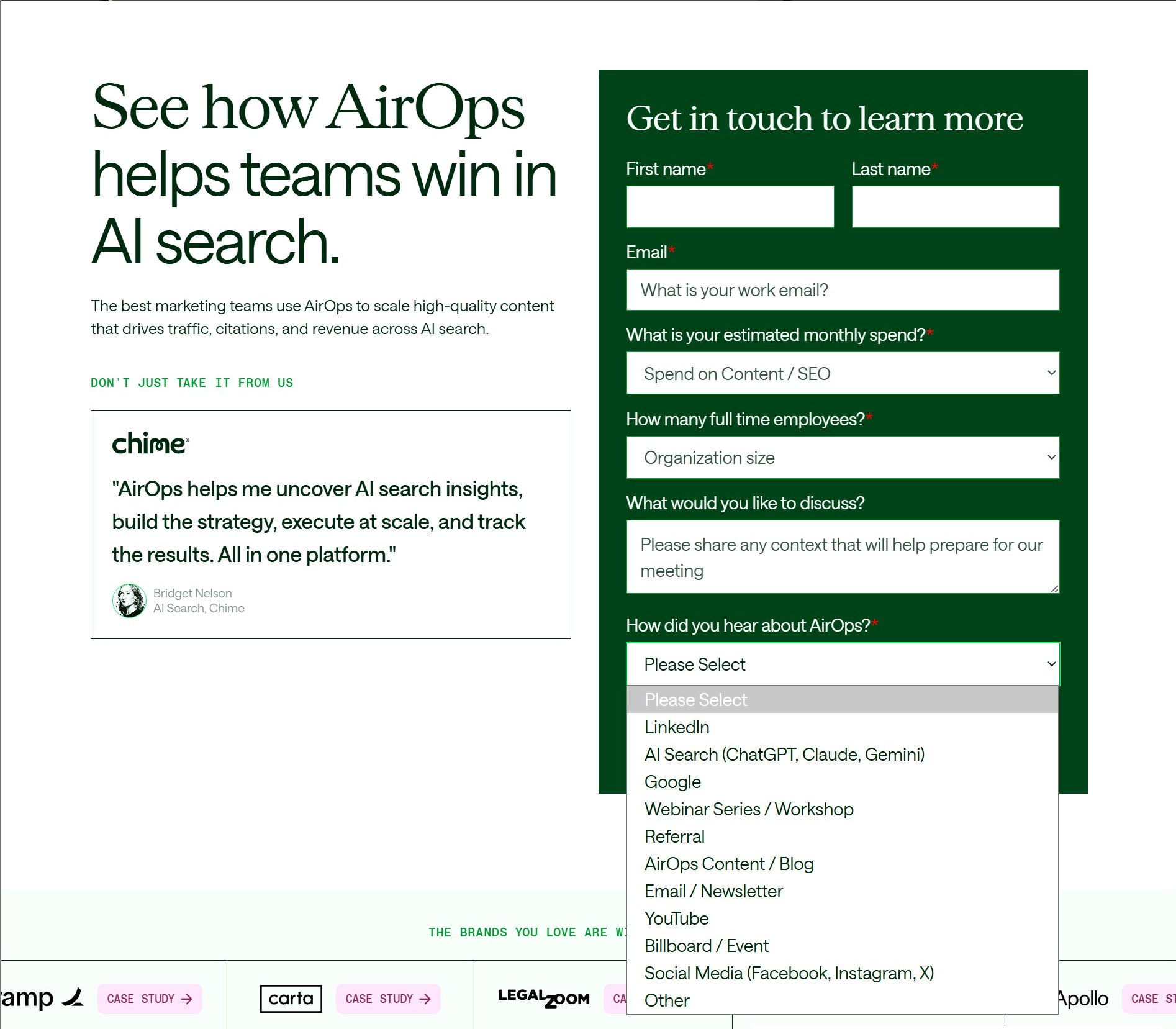
If a lead comes in marking themselves as having found the brand through AI search (i.e., AI mode, AI overview, ChatGPT, Gemini, Claude), sales needs to act on that during that actual discovery call.
We don’t want it to take away too much from the actual discovery call, but a brief “We saw you found us through AI search, what prompt did you use to find us?” can unlock a wealth of information.
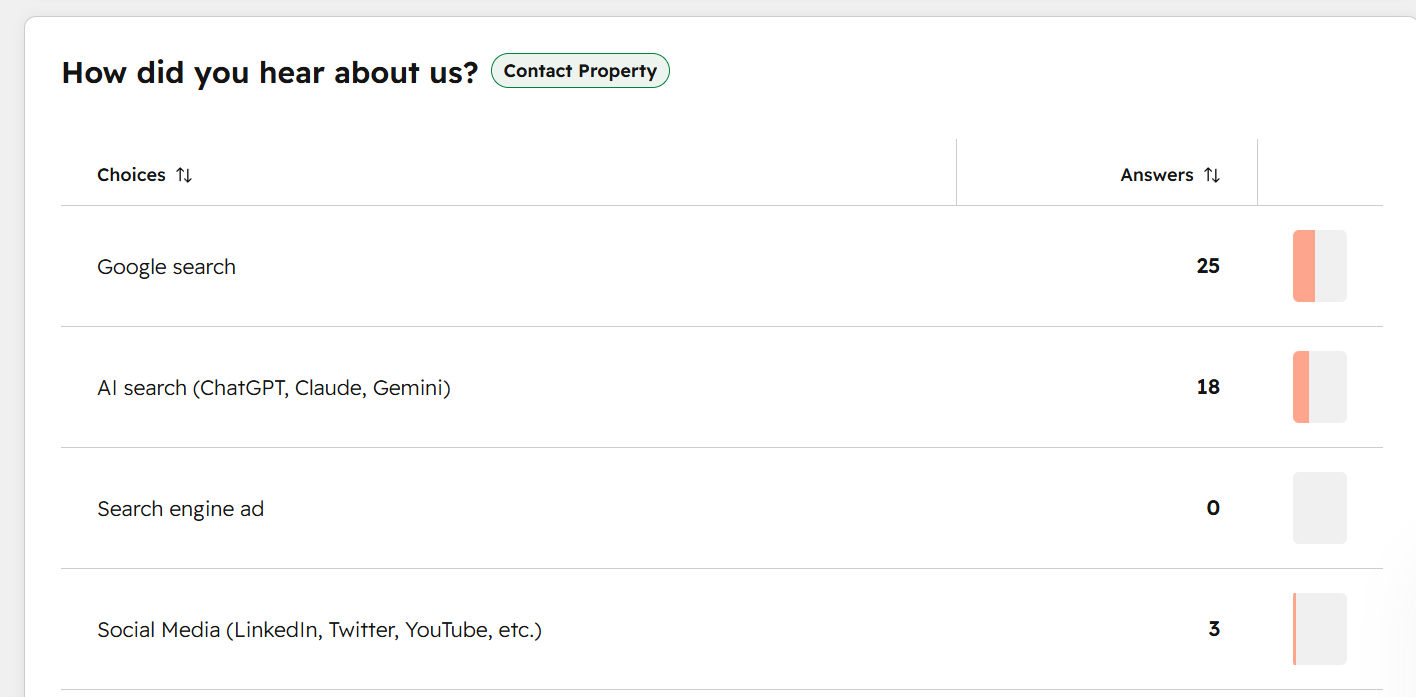
Funny enough, we’ve seen in a few cases where prospects will actually pull up their LLM conversation and show the exact set of questions they used to find and evaluate my client.
Again, this yields a wealth of data we can’t access elsewhere.
Your qualified leads are showing us exactly what criteria they evaluated us on, which leads to us deciding what we could be doubling down on, whether that’s:
- Sales enablement
- Documentation content
- FAQs
- Product pages
- Comparison pages
- Explainer articles
2. Mapping the likely questions users are asking when discovering, considering, and evaluating their options
Once we have enough user context, we can then map the questions that will likely arise at each stage of the buyer’s journey.
The goal here is full coverage of your brand and all the specifics of your product.
Especially when LLMs aren’t just using one search to grab information about your product and brand.
These are called fan-out queries; if you’re unfamiliar with them, you can learn more here.
But essentially, if I use a prompt like: How does Gong compare to Chorus for sales call intelligence?
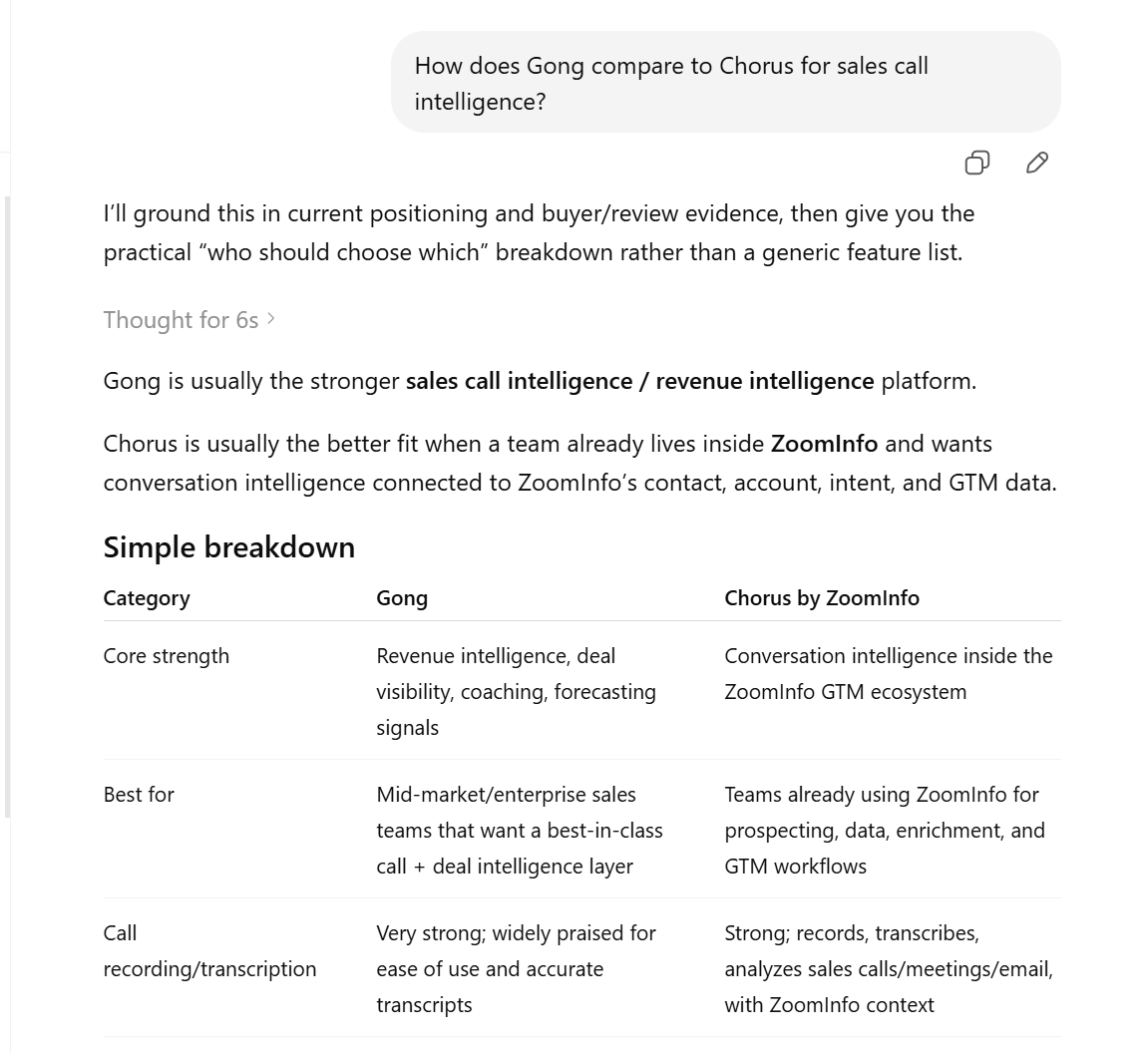
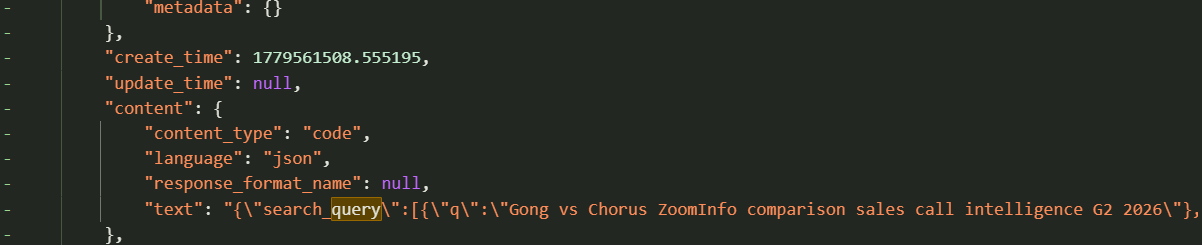
ChatGPT will perform multiple searches that include:
- Gong vs Chorus ZoomInfo comparison sales call intelligence reviews G2 2026
- Gong pricing Chorus pricing ZoomInfo Chorus 2026 sales intelligence conversation intelligence
- Gong Chorus alternatives sales call intelligence G2 reviews
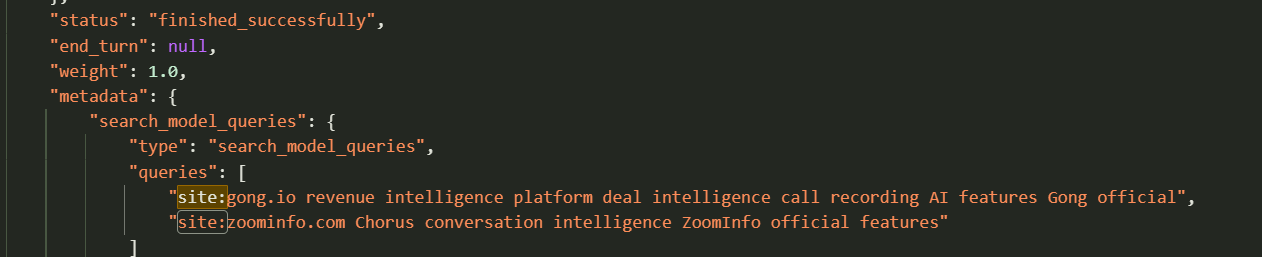
Not only that, but ChatGPT will also use site operators for each site to gather specific info like:
- site:gong.io revenue intelligence platform deal intelligence call recording AI features Gong official
- site:zoominfo.com Chorus conversation intelligence ZoomInfo official features
So when I say we need full content coverage, it’s so that LLM systems can capture as much information as possible during this fan-out process.
But generally, for any lower-funnel prompt (like the comparison one above), there will be around 90% overlap in the queries generated by the fan-out process across industries.
So the fan-out process will typically grab:
The other 10% of queries will generally be industry-specific, and what sales can help out with.
In addition to capturing pricing, reviews, and documentation, the fan-out queries will also include industry queries that vet for specific features.
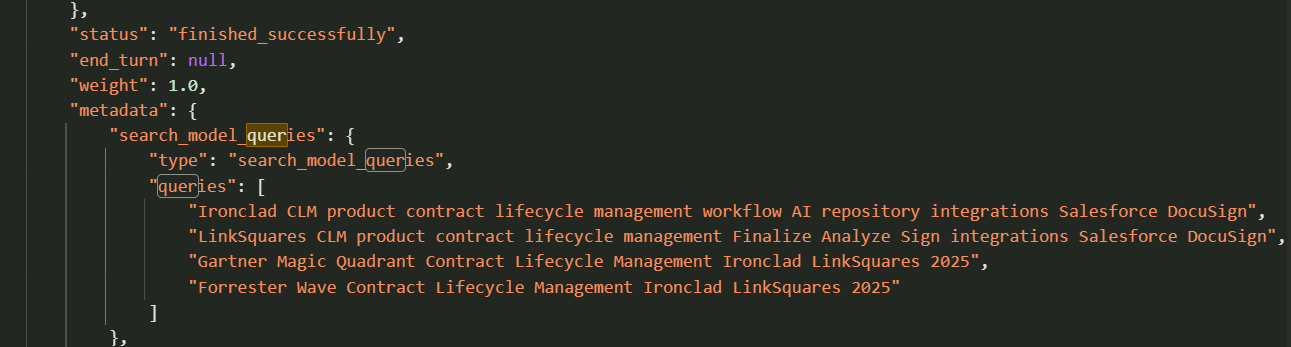
So if a user were looking into legaltech products that involve compliance and security, the fanout process would look very different. You can see that here in this prompt:
Our legal team is evaluating Ironclad and LinkSquares to manage our vendor and customer agreements. Which one is better, and are they secure enough to handle sensitive enterprise contracts?
Fan-outs include:
- Ironclad security compliance SOC 2 ISO 27001 GDPR enterprise contracts
- LinkSquares security compliance SOC 2 ISO 27001 GDPR enterprise contracts
- Ironclad vs LinkSquares CLM reviews G2 Capterra legal operations
- LinkSquares vs Ironclad CLM reviews legal operations
- Ironclad CLM product contract lifecycle management workflow AI repository integrations Salesforce DocuSign
With pages being crawled like:
- security.ironcladapp.com (Ironclad's public SafeBase security portal)
- linksquares.com/security/ (LinkSquares' dedicated security hub)
- vanta.com/customers/ironclad (Case study)
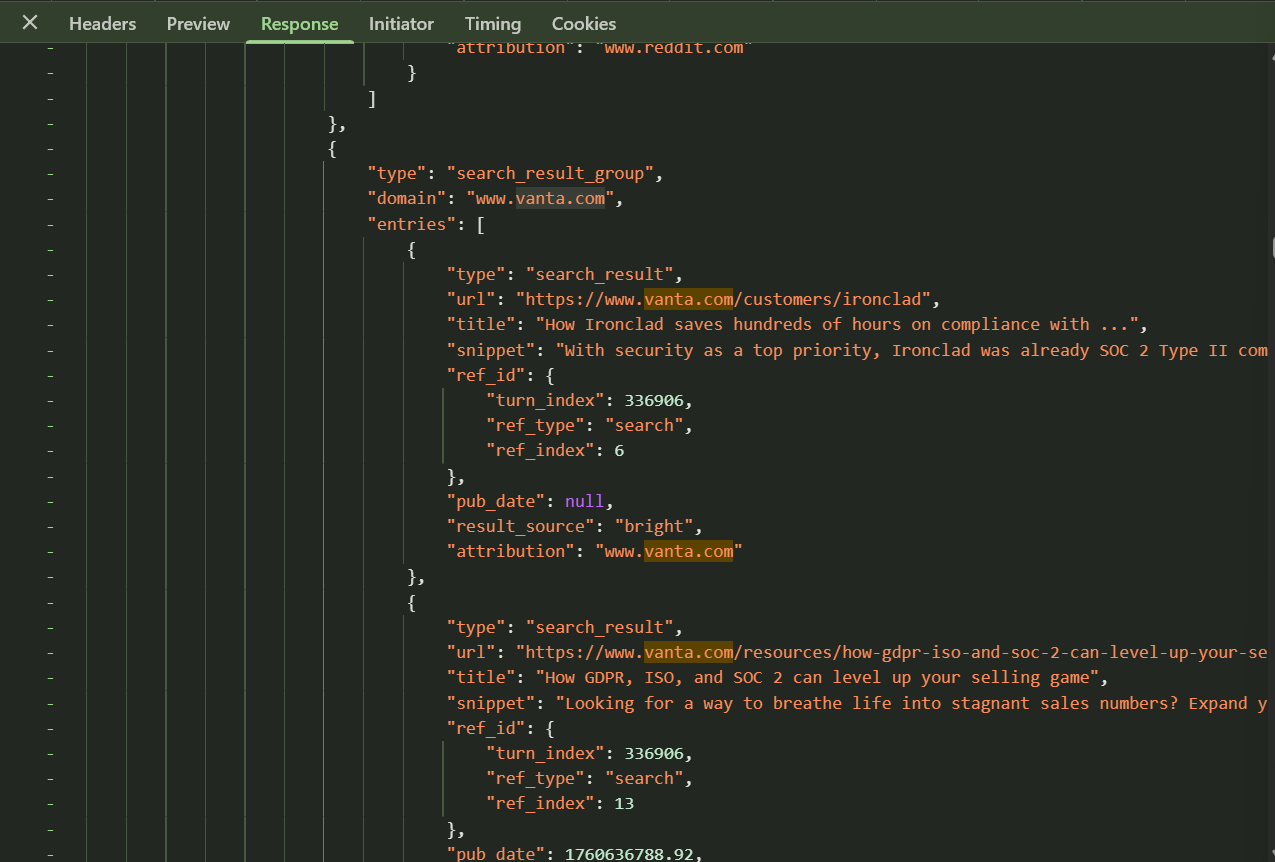
Every industry will have a different subset of queries to understand. That’s why sales, as the frontline to your customer, can highlight what features customers are frequently asking about.
Once we have that information, we can reverse-engineer the types of industry-specific queries and pages that will be pulled during the discovery process.
And finding these industry-specific queries starts with understanding what your customer specifically wants, with sales generally being your closest ear to the customer.
So this boils down to:
- Talking to sales to learn what customers care about/search for
- Replicating those searches on LLMs to find out which queries are being generated
- Seeing what kind of pages LLMs are pulling from during the fan-out process
- If our pages are missing from that pool, then we’ll need to either re-optimize or build out an entirely new page
Once we have that information, we can compile a list of pages that will influence how users interact with our brand.
Just a note: It’s not enough to just “build” these pages out. They can’t be vague marketing lingo pages. They have to be grounded in specifics around your product and what it actually does.
Brand and product context will always come from the specifics, so that technical writing will be your best friend here. Again, a reason why positioning matters so much for this: “We’re an enterprise digital solution” won't cut it. It never did anyways, but now even more so.
3. Mapping your product to pain points and JTBD’s, specifically for “how to” searches where brands are mentioned in outputs
The previous sections covered high-intent prompts where users are actively shopping. But there's a middle-of-funnel angle I never hear discussed enough: certain "how-to" topics now function as transactional prompts.
The shift is pretty simple:
- Traditional MoFu: Someone searches a problem, clicks your article among the other results, and decides for themselves whether your product fits.
- MoFu in LLMs: The user never clicks around to weigh options. The LLM just recommends a product the moment it recognizes one is needed to get the job done.
When I ask ChatGPT "how to add voice notes to a PDF," it tells me Adobe Acrobat is generally the best way to do it. I didn't ask for a product recommendation, but it gave me one anyway:
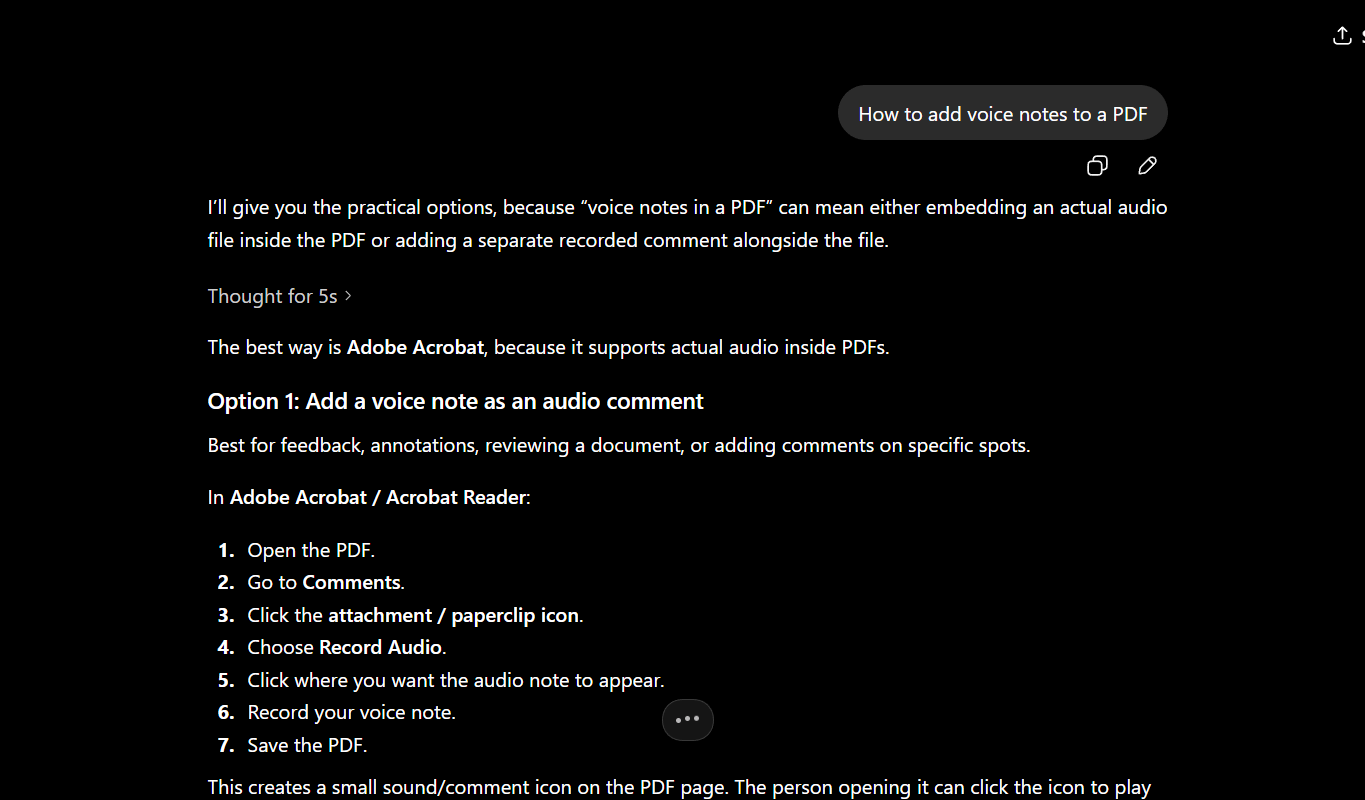
LLMs are giving product recommendations without being prompted, so that’s a whole new area of prompts that we’ll ideally want to capture.
This type of content is generally easiest to map, especially when we have access to that sales data. We’ll just need to:
- Understand what customers are using the product for
- What prompts trigger these product recommendations
- What pages are being sourced for these recommendations
From experience across verticals such as hospitality, employee experience, cybersecurity, and MarTech, the overwhelming majority of these pages will be sourced from documentation hubs or “how-to” explainer articles.
This introduces an entirely new layer of optimization, as documentation hubs are now cited in 17% of outputs.
4. Establishing consistent context that doesn’t just come from your website
A major factor that I haven’t touched on too much will come from PR.
With first-party content hosted on your site, it is much easier to control what you want to say about your brand.
But with AI search specifically, PR is a core component of how your brand gets visibility.
In a brand visibility study for AI overviews, Ahrefs found that the branded web mentions, along with branded anchors and brand search volume, correlated most with brand appearances in AI overviews.
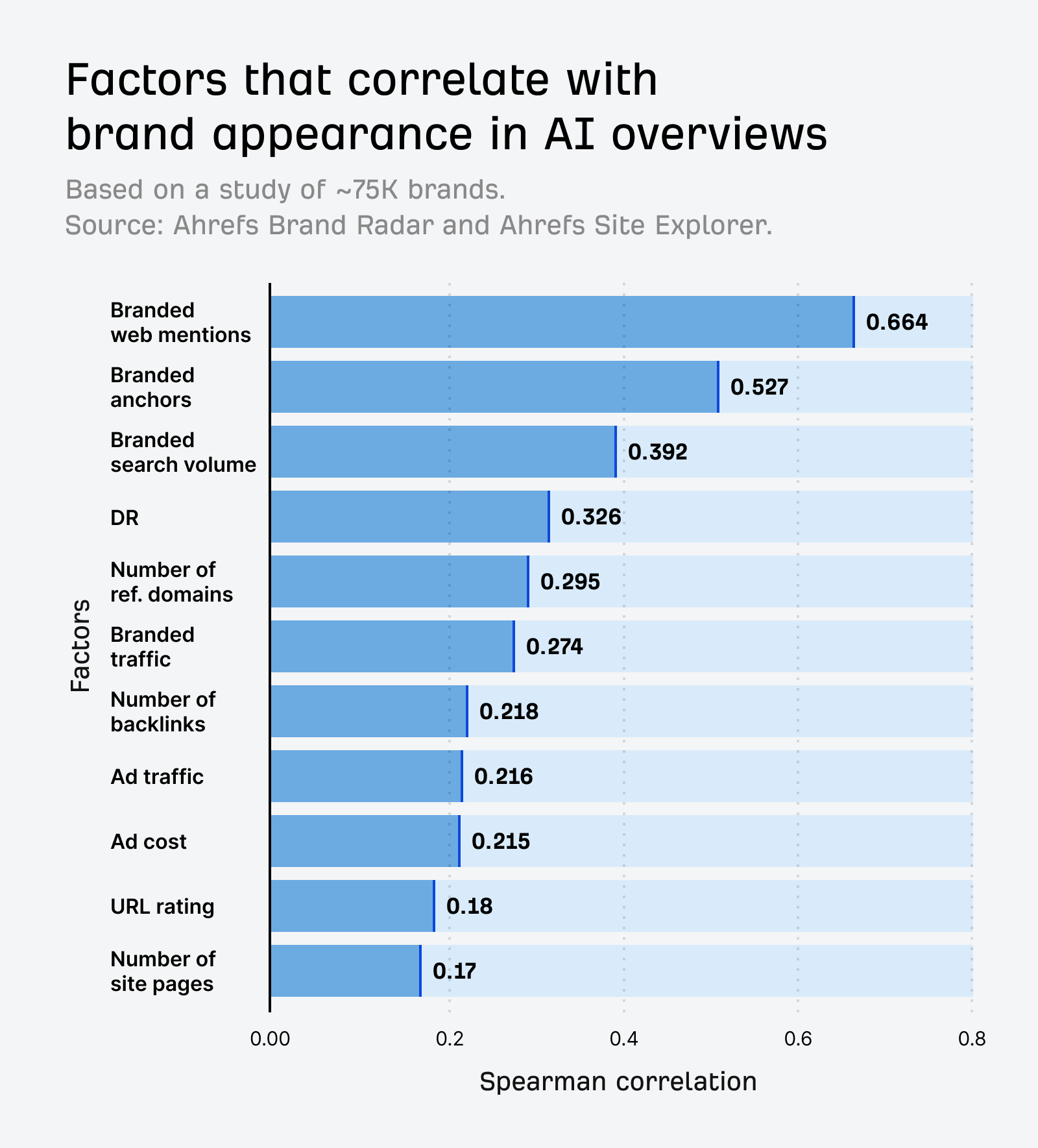
Simply put, brand visibility across the web (not just your own website) is a core part of how LLMs recommend brands. Or as Andrew Holland brilliantly phrases it, fame engineering.
But as we know, the web is quite large, and there’s likely a ton of conflicting information about you.
Whether it’s from inaccurate or outdated articles, these can result in LLMs either retrieving incorrect information about you or skipping your brand entirely, as there isn’t a clear signal about what you do.
But even beyond inconsistent information, we want to build upon our established marketing fundamentals and continue to build awareness in our marketing category. Like link building, contextual mentions matter quite a bit for AI search.
So just getting “PR coverage” isn’t enough to help you. Your goal will be to build contextual mentions across the web that further position and establish you in your category.
Your own website can only take you so far.
When LLMs are putting together a synthesized answer, you need:
- Websites furthering your claim that your product is the undisputed best option for that category
- Positive user sentiment around your product. Overwhelming negative reviews can either prevent LLMs from recommending you or even warn prospects to be cautious with your product
- Consistent brand positioning across the web to prevent LLMs from being unsure whether your brand actually belongs in its product category. A misleading or conflicting consensus can lead to LLMs skipping you for a competitor who is more clearly positioned in that category
Simply put, what your website, competitors, and third-party websites say about you will shape how prospects will interact with your brand on LLMs.
5. Ensuring LLMs can properly access your content (so essentially technical SEO)
Since LLMs lean heavily on search engine APIs to pull current information, the technical basics decide whether they can even use your content:
- Indexability and crawlability: If a page isn't indexed or crawlable, it won't make it into the responses LLMs build.
- Clean HTML: Most LLMs (Gemini being the exception) can't render JavaScript, so anything not readable from clean HTML is hard for them to extract.
So if your content isn’t readable from clean HTML, LLMs are going to struggle to extract that information.
How we measure success
How we have always measured success comes down to pipeline revenue, short and simple.
While I don’t see that changing any time soon, the method we use to attribute revenue has become much more difficult.
While GA4 is handy for conversion tracking, there are a few other metrics that are needed to gauge revenue that has been influenced by LLMs
Here are the ones that matter most to us:
Each metric will serve its purpose, but we track all of these to measure performance directionally.
All of them will directly tie into whether our revenue is being influenced by LLMs and how we can replicate that success across more areas of the business.
AEO tactics I don’t believe in
Before closing, I want to address the tactics I consider a waste of time.
Again, this is based on personal experience and experiments I’ve run across different verticals. So I don’t want any “GEO bros” spamming my comments about this.
The ones I give zero attention to are:
However, some tactics are worth exploring.
I don’t have a set opinion on any of these for AEO specifically, but I think experimenting with these could be interesting:
- Entity summary pages
- Schema markup
- Meta descriptions
- WebMCP
Google’s stance on all of this
There’s been a lot of talk recently about the documentation Google rolled out that highlights its best practices for optimizing your website for AI search.
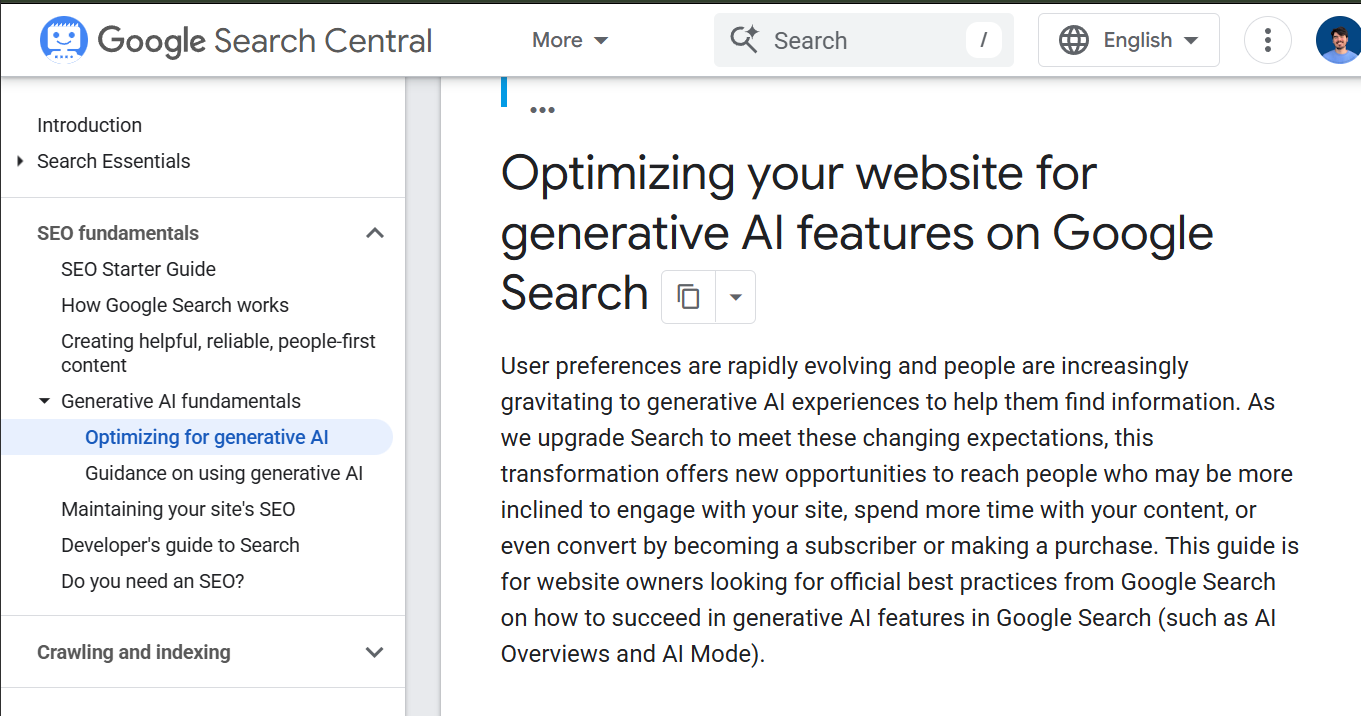
The documentation includes:
- If SEO is relevant for generative AI search (which they say it is)
- Foundational SEO best practices that apply to AI search
- Tech SEO best practices for AI search
- Google’s takes on AI search myths such as chunking, LLMS.txt files, and seeking inauthentic mentions
This documentation should be required reading for all SEOs and marketers, as Google’s tactical recommendations/guidelines are mostly accurate (excluding inauthentic mentions - more on that later).
Google’s stance boils down to this: Good AEO comes from good SEO.
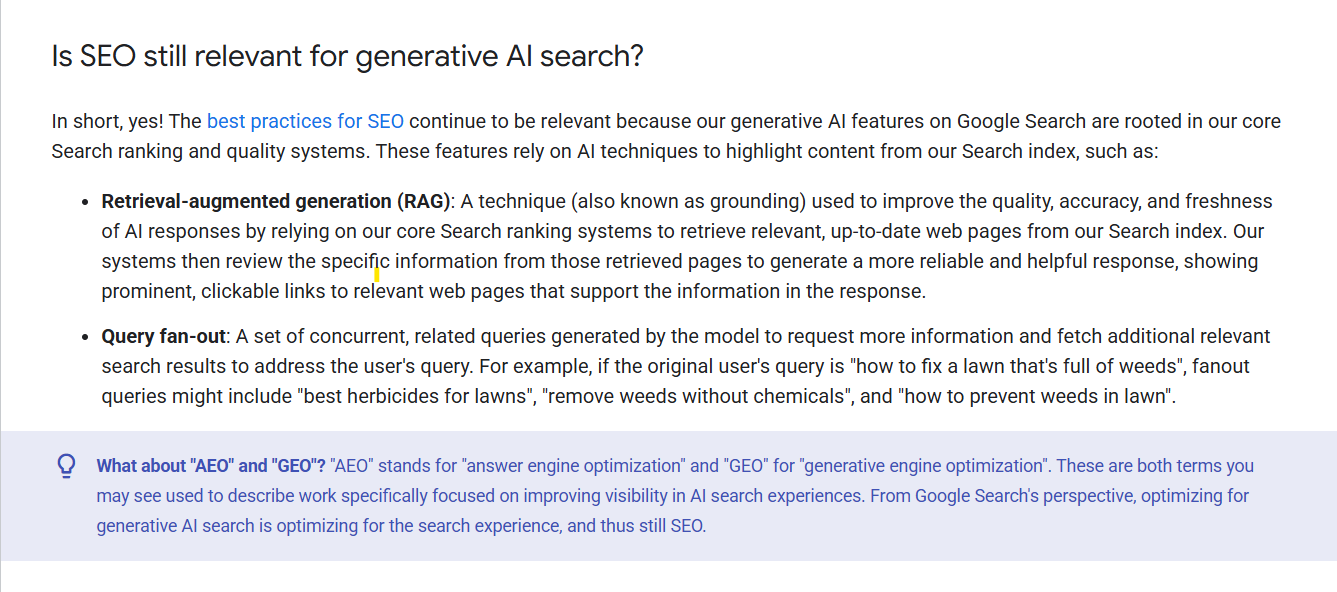
Now, while I ultimately believe Google’s tactical recommendations are correct, I believe this documentation is misleading for marketers.
The problem with following Google’s guidelines is that it only applies to citations.
Citations that are currently getting a less than 1% CTR on AI overviews and AI mode, according to Pew Research.
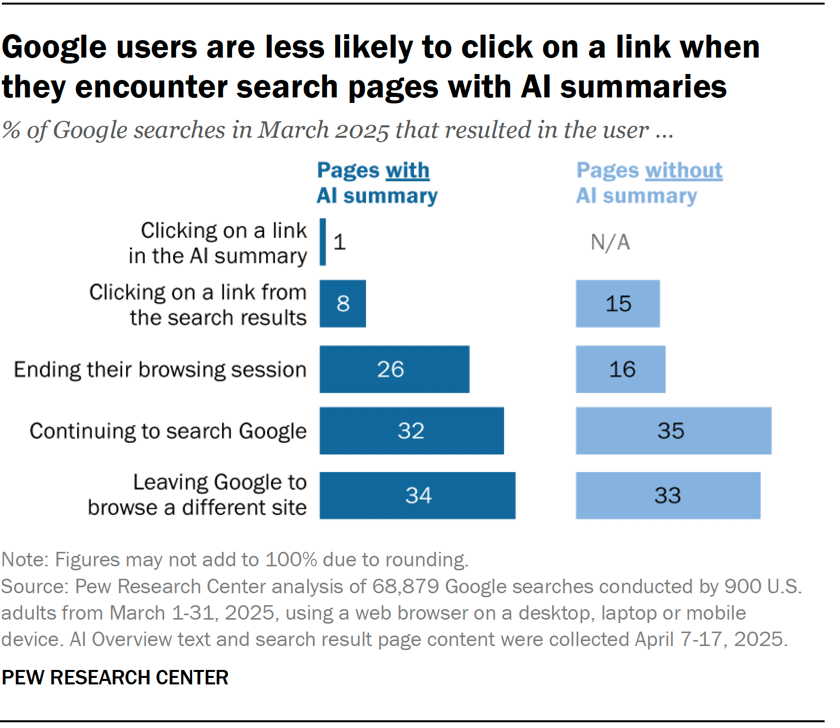
Now, I don’t think citations are entirely useless; they have their place.
But the problem arises when you use them as a leading metric (similar to using rankings as a primary metric for SEO performance).
But like clicks and rankings, citations don’t bring in revenue.
Brand mentions do. In AI search, brand mentions and citations are the two of the main metrics you’ll need to know:
- Citation = A link that’s included in the AI summary, either as an in-line link or included in the sidebar
- Brand mention = When the LLM is directly referencing your brand or product as an option when your buyer is researching products.
A brand mention is ultimately what gets you added to your buyers' consideration pool, as 51% of B2B software buyers start their research with an AI chatbot more often than with Google.
And that’s not including the fact that users are then treating LLMs as an outlet to evaluate these brands and consolidate their shortlist to a small handful of products that best match their needs.
So not only do we have to aid the discovery process for your brand, but we also have to ensure that LLMs properly understand who you are when users are gauging which product is best for them.
Why I view AEO as a subcategory of SEO
One thing I want to clarify is that I don’t see AEO and SEO as completely different entities, nor 1:1 matches.
I view AEO as a subcategory of SEO, similar to SEO being a subcategory of marketing. Same fundamentals, unique approach.
There’s plenty of nuance to this, of course, to the point where it could be an entire article (I talk about here in this GEO vs SEO article I wrote).
But when I say AEO and SEO are different yet similar, I’m talking about how the tactical overlap between them is around 95%, but each strategy requires a different approach.
With SEO, I’m predicting all of the possible branded and non-branded searches your ICP is performing where we can insert ourselves into their buyer’s journey.
Maybe that’s a product page that ranks for a core software term they’re searching for, or it could also be a comparison page when your prospects are comparing you to your closest competitor.
This could even be as simple as them searching for your pricing information.
Whatever it is, I’m predicting that all searches will end with a click to your website, where we can ultimately have them explore your site further, with CRO already in place.
Why AEO needs its own subcategory
Now, with AEO, I expect that the user won’t click through to your site until they’re at the final stage of purchase.
LLMs allow prospects to summarize a wide corpus of public data around your brand, including case studies, product pages, reviews, testimonials, and Reddit threads.
We’re seeing that a majority of the sales process — including discovery, consideration, and evaluation — is now being influenced by LLMs.
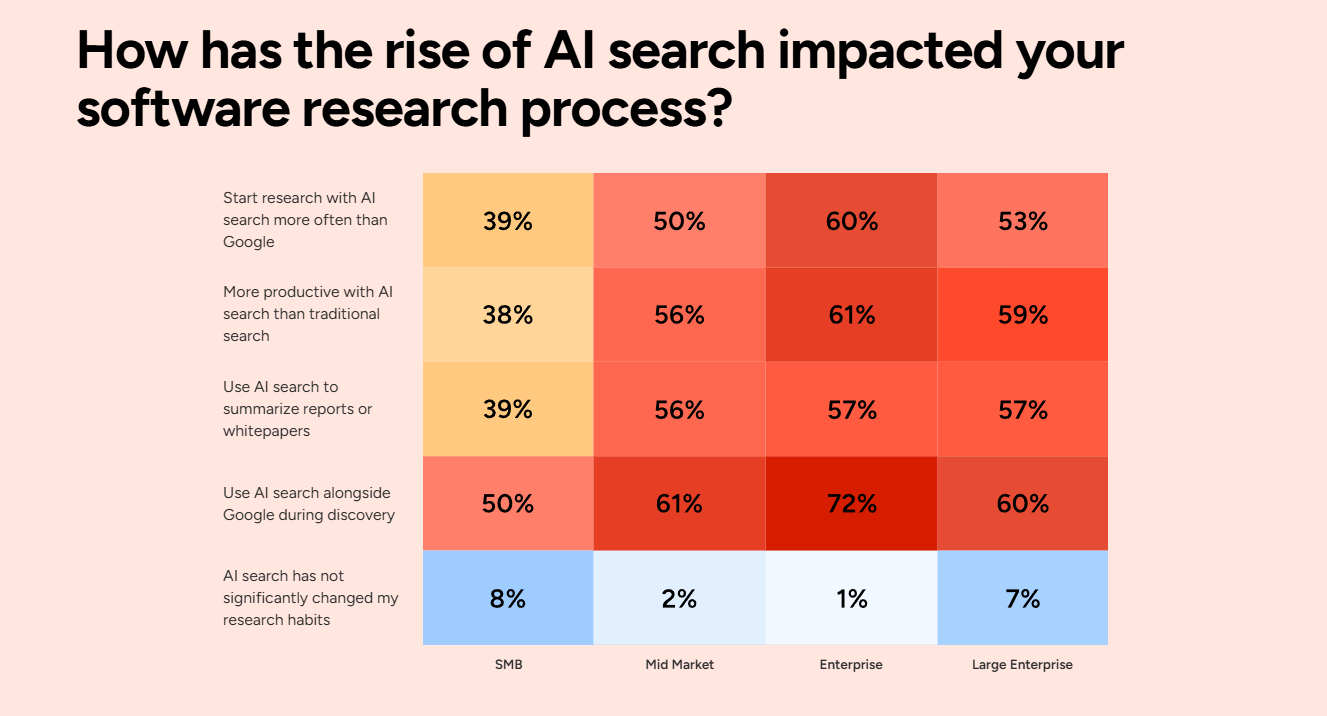
Even before chatting with your sales team, prospects are coming into calls understanding:
- Your product’s use cases
- Competitor comparison differences
- Pricing info
- Which job position it’s best for
LLMs are essentially acting as an extension of your sales team, or so we want them to be.
That’s where AEO comes in.
We want LLMs like ChatGPT, Gemini, and Claude to be your perfect sales partner. This means these LLMs have to be able to:
- Reference accurate, up-to-date information about your brand
- Support sales-related questions users are asking about your product and brand
- Allow your brand to be discovered and referenced when users are performing initial product research
And it’s up to us to provide them with the resources they need to do it. SEO is one of the levers for growth (more on this later), but the actual strategy/approach requires much more than just SEO.
Brand context, SEO, and PR are the backbone of every engagement
At its core, brand context, SEO, and PR are what ultimately get your brand visibility on LLMs.
My view on AEO all boils down to:
- Having your marketing fundamentals set (i.e., positioning, product market fit, differentiation strategy)
- Properly positioning your brand/product in your category through SEO, content marketing, and PR so you become the most relevant and recognizable name for your category
- Have content that explains how your product works in detail
- Have content that answers the specific questions users have about your brand and product
There’s no need to make this too complicated or technical. In my eyes, strong AEO is achieved by building on already established marketing fundamentals, and all I’m helping you do is amplify that through content and PR.
Don’t let LLMs skip over your brand