

.png)
TL;DR
I pulled ~3,400 public comments (Reddit + YouTube) in the week after Google's I/O search overhaul and ran each through sentiment analysis. Reaction was ~74% negative, and five of six audiences clustered in a tight 73–84% range.
The top complaint everywhere was accuracy: people don't trust AI answers and don't want AI taking the wheel. Even AI enthusiasts hit 73% negative, so this isn't "AI bad," it's bad execution and forced adoption. DuckDuckGo was the most-named alternative.
So Google announced what they're calling the biggest change to Search in 25 years at I/O this year on May 19th.
The AI-first search box, expanded AI Overviews, and the full AI Mode rollout.
Now, with AI backlash growing and over 55% of Americans seeing AI as causing more harm than good, I was genuinely curious about public sentiment around this rollout.
As someone who is very active on Reddit and LinkedIn, I was seeing negativity everywhere. Mostly outside of the tech bubble.
But I wanted to measure this on a larger scale, which led to this study.
I pulled around 3,400 public comments in the week after the keynote and ran every one through sentiment and theme analysis.
The overall reaction came in at about 74% negative.
The thing people distrust most, by a wide margin, is whether the answers are even right.
However, with all the negativity around Google’s change, there was one group that was surprisingly more positive/neutral about the change. A group I’m sure none of us would expect.
One honest note before the numbers: This is a read on public discourse, not a poll of every Google user. Reddit and YouTube comments tend to skew more negative and generally complain a lot (I’ve seen this plenty first-hand). People who quietly like something tend not to write a paragraph about it. So I'd take all of this as a snapshot of online discourse, not every Google user that’s out there.
Methodology
Before we get into the actual data, here’s a quick rundown of the method:
- Sources: I pulled public comments from YouTube (major news and tech publishers, plus Google's own announcement video) and Reddit threads reacting to the keynote. 41 sources in all, grouped into six audiences: general public, neutral tech, AI enthusiasts, AI skeptics, mainstream non-tech, and the SEO/publishing crowd. On Reddit, I pulled top-level replies + 1 level down.
- Filtering: I started with about 6,000 comments and narrowed to the ~3,400 that were actually about the search change. Not Gemini models, not smart glasses, not the rest of the keynote.
- Tagging: Then every comment was run through an LLM (Claude) that scored three things: sentiment, the one-to-three themes it expressed, and whether it was genuinely about the search change. I spot-checked the output against the raw comments, tightened the rules where it slipped (it kept reading competitor gripes as Google reactions, for one), and re-ran the whole set.
- Cohorts: The audience cohorts are based on the communities where each comment was sourced. That's the part I care about most, because it lets me compare reactions audience by audience instead of mashing everything into one blurry average.
And just to be clear on scope: This is two weeks after the announcement. How users actually adapt to the change is something time will only tell.
Cohorts were categorized as follows:
- General public — YouTube comments on Google's own I/O announcement video, plus The Verge and CBS News. The broadest, least niche crowd in the study, and the one that ran the hardest negative.
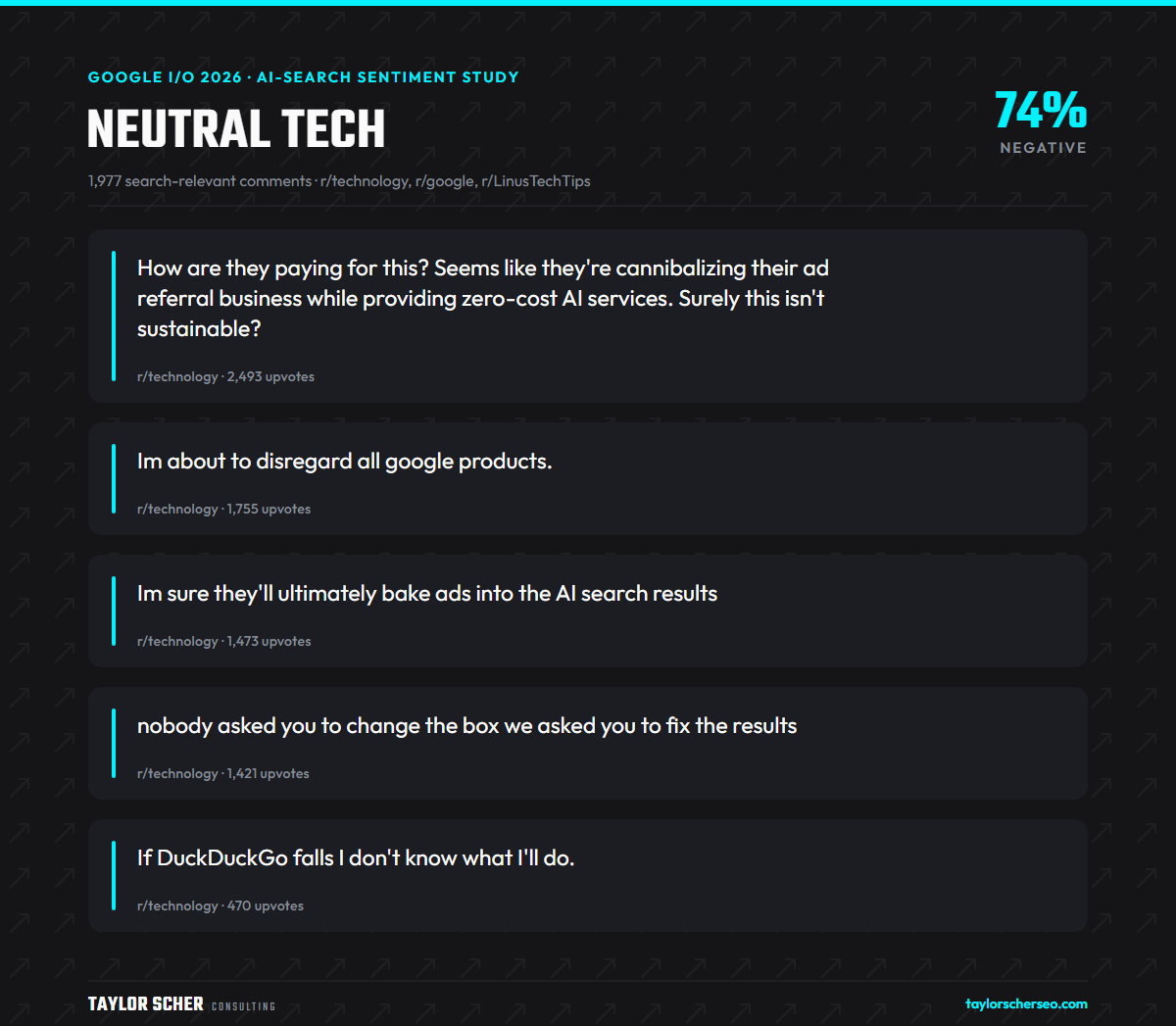
- Neutral tech — r/technology (which makes up the bulk of the whole dataset on its own), r/google, r/LinusTechTips, r/tech, and r/gadgets. Tech-literate, but not here to grind any particular axe.
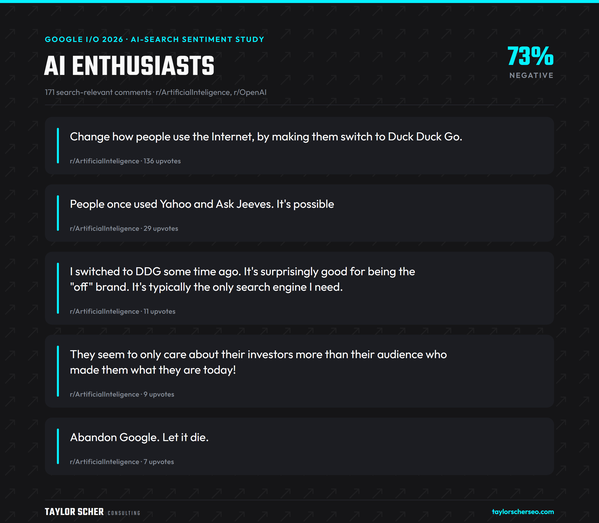
- AI enthusiasts — r/ArtificialInteligence, r/OpenAI, r/singularity, r/artificial, r/ChatGPT, r/GoogleGeminiAI, r/Bard, r/GeminiAI, r/accelerate, and r/Futurology. People who follow the models closely tend to be first in line to defend this stuff.
- AI skeptics — r/antiai and r/BetterOffline. Predisposed to be critical going in, so the negativity here was more expected than telling.
- Mainstream, non-tech — r/news. General-interest and pop-culture communities that aren't here to talk shop.
- SEO / publishing — r/SEO, r/localseo, r/Blogging, r/content_marketing, r/bigseo. The crowd whose traffic is most directly on the line.
The overall mood: not happy
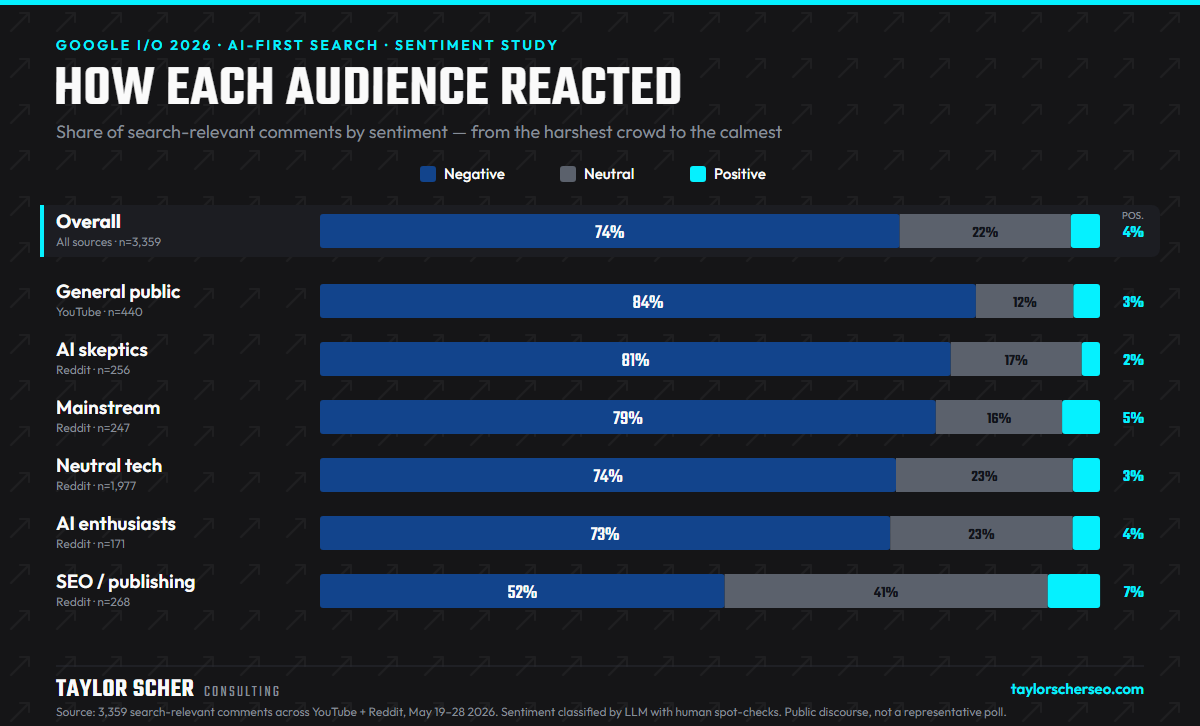
So here's the thing: Across basically every audience, the reaction was overwhelmingly negative.
About 74% negative overall.
Five of the six audiences landed somewhere in that 73 to 84% range, which is a tighter clustering than I expected going in.
Positive sentiment never cracked double digits in a single group. Shockingly, the most positive cohort managed to be the SEO cohort, at around 7%.
The single most-upvoted comment in the entire study, sitting north of 6,400 upvotes in r/technology, pretty much captures the mood:
"Thanks, I hate it. But seriously, I really hate the idea of results being so opaque. I want to do the final sorting and thinking myself, I don't want AI to do it."
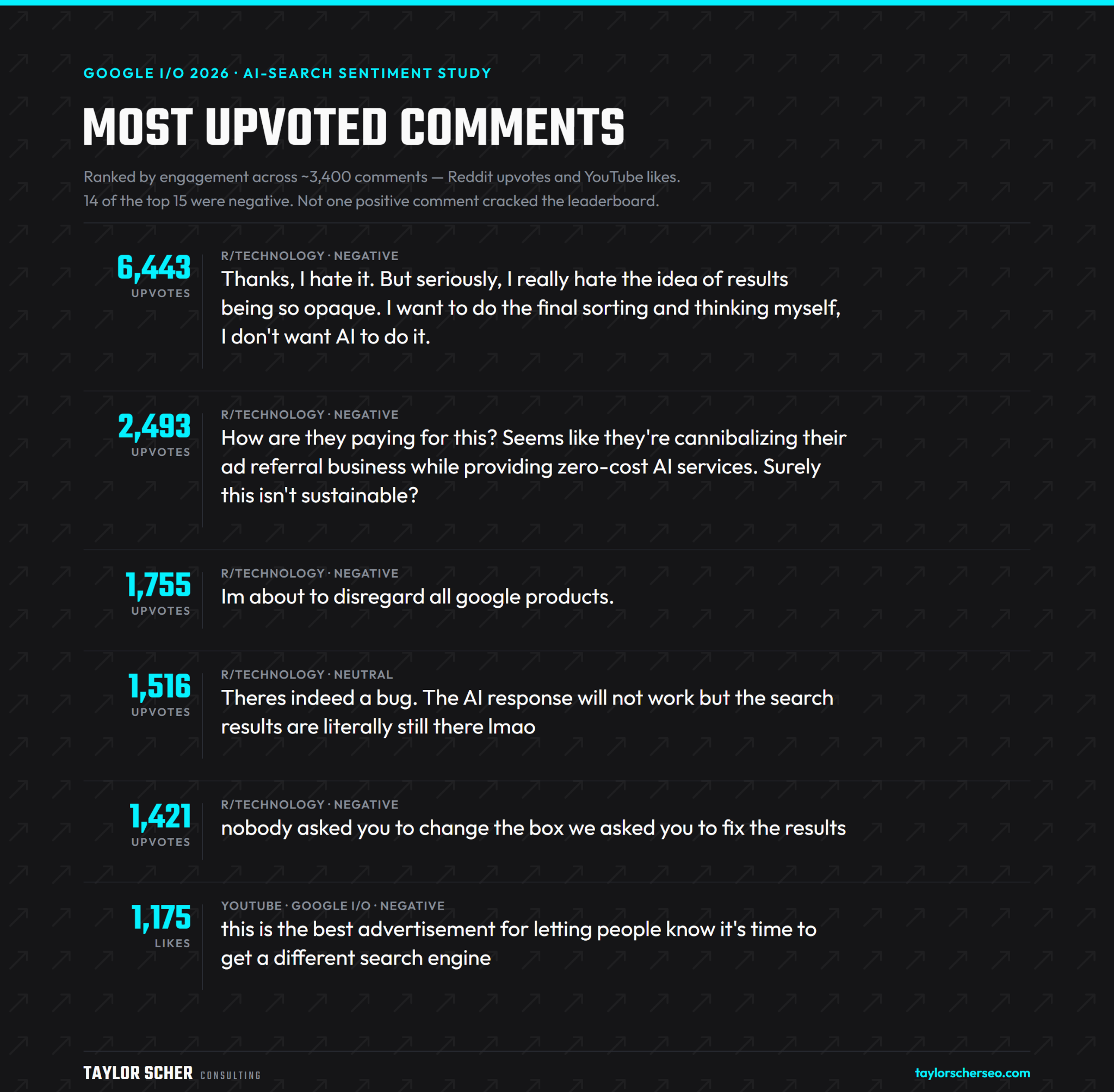
That comment says it all, honestly.
It's not "AI = bad." It's "don't take the steering wheel away from me."
That sentiment seems to show up pretty consistently throughout all of the comments.
What people actually talked about
But what about what people are actually saying? What’s the shared sentiment across all the comments?
So I went looking for the overlap to see what themes kept showing up, and which clustered together. A comment can land on more than one theme, so these add up to more than the total.
Here's the breakdown across the categories.
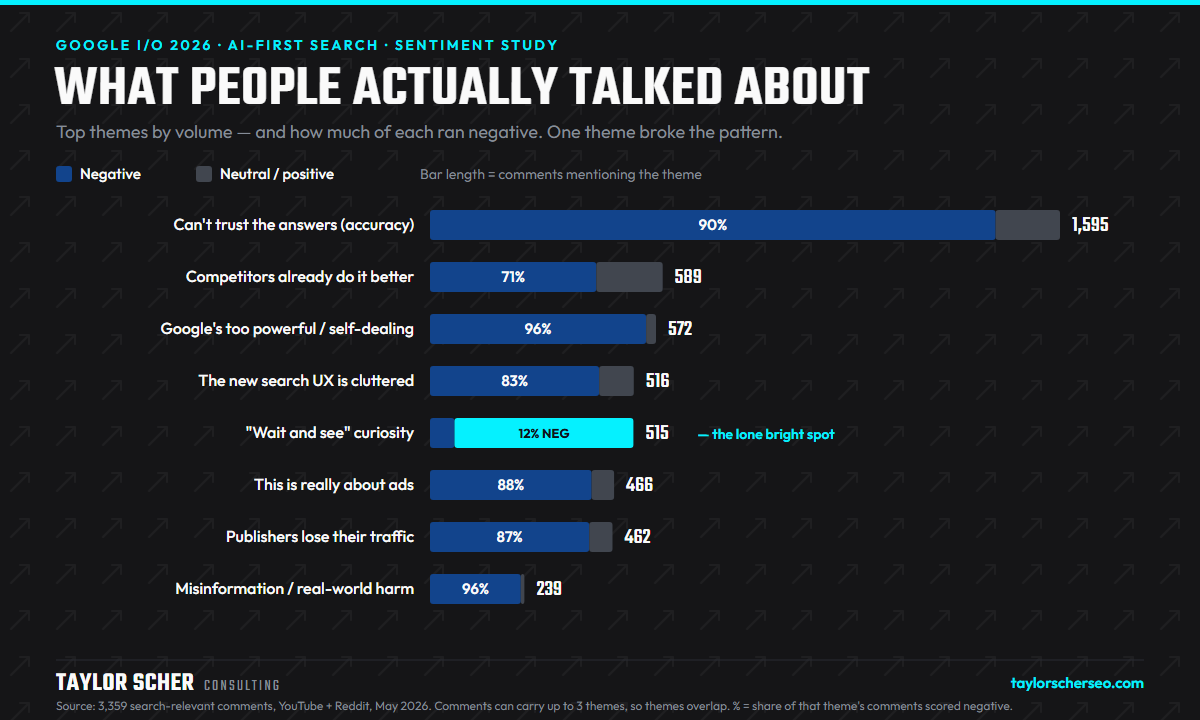
To the surprise of no one, hallucinations and inaccurate information were the primary concerns people had with the new setup.
And the frustrating part is that the accuracy is actually pretty good.
The NYT found Google's AI Overviews are accurate 9 times out of 10. That sounds great until you sit with it for a second.
Google is running somewhere in the ballpark of 13 billion searches a day, so even a 1-in-10 miss rate is a staggering number of wrong answers in absolute terms.
And they appear right at the top of the page, where Google has placed the “best” results for decades.
That means users are far less likely to scroll down and check the rest of the results to build their own answer. Meaning, a good chunk of users are taking the AI’s output at face value without any additional fact-checking.
DuckDuckGo was the backup plan for most people
Just over 1 in 7 of the comments named a specific alternative search engine to switch to.
DuckDuckGo was far and away the most common, appearing in 331 comments across all six audiences.
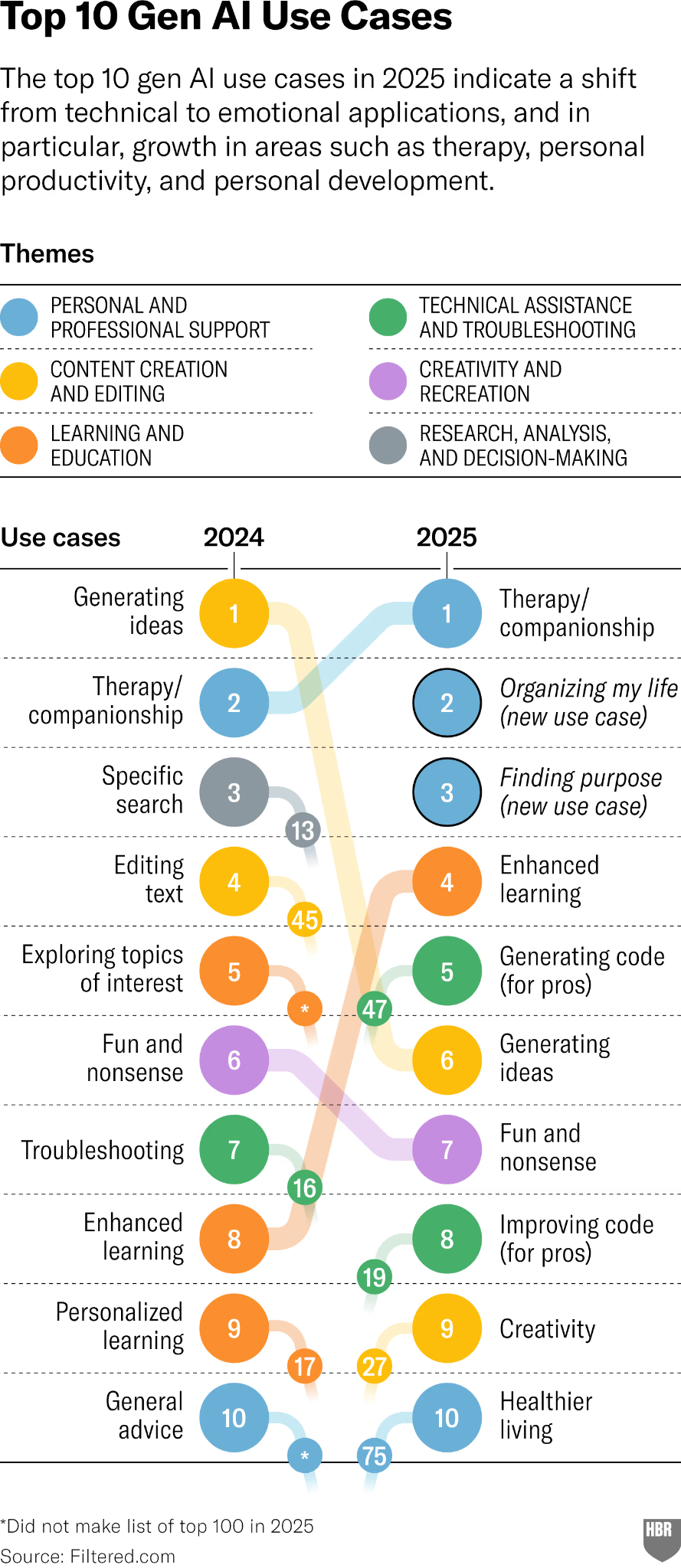
Ecosia, Kagi, Brave, and Startpage came up too, and on the AI side, people mentioned they’d rather Google Search stay in its same format rather than replicate an LLM's interface. Which could make sense as Harvard Business Review found that AI searches were a top 3 use case on LLMs in 2024, but that dropped down to 13 in 2025.
DuckDuckGo even runs an AI-optional version of its search that keeps getting linked as the best alternative.
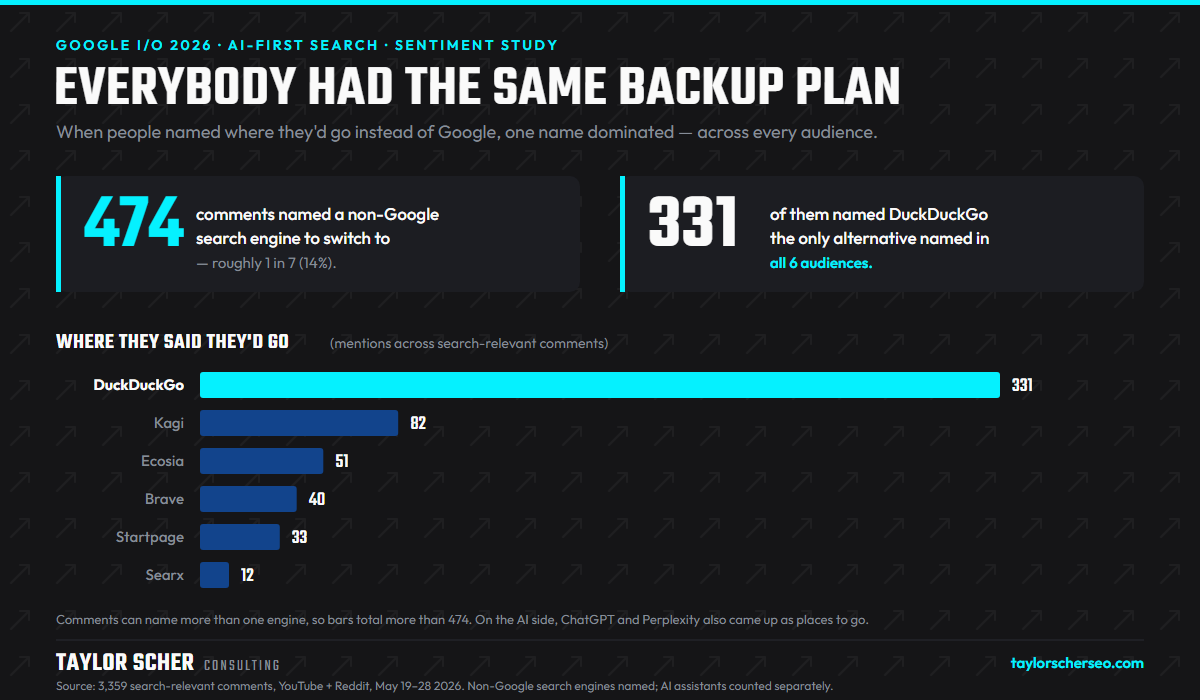
This is even more interesting as DuckDuckGo saw an increase of 30% after the Google I/O.
Here's the thing: When the same alternative is named by AI skeptics, the mainstream non-tech crowd, SEO pros, and the general public, it's no longer a niche tech-forum thing.
"Nice Duckduckgo advertisement. Goodjob."
"DuckDuckGo it is, then."
"Really pleased with my decision to switch to DuckDuckGo holy shit."
"If DuckDuckGo falls I don't know what I'll do."
But just because people are saying they’re leaving Google for DuckDuckGo doesn’t mean they actually will.
We saw it with Elon Musk buying Twitter and renaming it X. BlueSky was supposed to be the new replacement. But how many people do you know who use BlueSky exclusively?
This skepticism was shared by someone on the AI-enthusiast side:
"Lol let's face it, 99% of people are not going to switch to Duck Duck Go en masse any time soon (or ever). But a few techies and redditors will switch for sure."
That's probably right. Stated intent to switch and actual switching are very different things, and Reddit is exactly the kind of place that inflates the former.
How each audience reacted
While every audience was negative towards the change, their reasoning and how they expressed it varied.
Splitting the results by cohort tells us where the change went wrong for different types of users. (Quotes below are real comments, lightly trimmed.)
General public (YouTube), 84% negative
The harshest critics came primarily from the comments on Google’s announcement video.
These are real users sharing their raw frustration and concerns about accuracy and not being able to just search for what they need like they’ve done for years.
It’s (mostly) not coming from people whose livelihood relies on Google Search. So they don’t care about the future of search, and they’re more likely to be anti-AI.
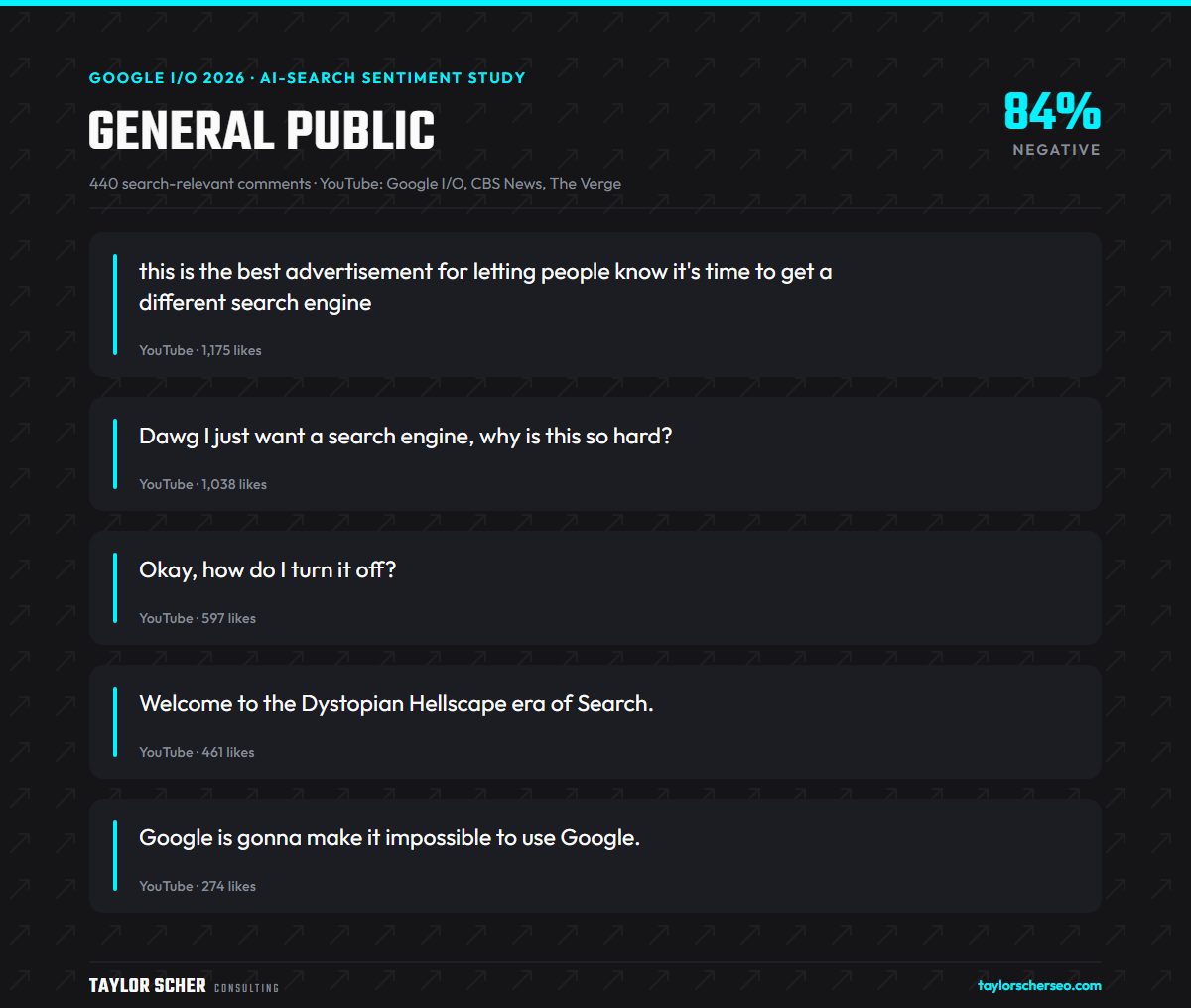
But it’s important to know that most of these comments came from Google's own announcement video, where the crowd is self-selected and primed to react.
So while 84% is eye-catching, it’s more raw-reactive than representative.
The Reddit cohorts below are the cleaner cross-section.
And for what it's worth, the more neutral tech-press coverage (a Verge podcast episode, for one) drew dramatically less negativity than Google's own video, which kind of tells you how much the venue alone shapes the number.
AI-skeptic communities, 81%
Unsurprisingly, anti-AI communities were critical. But, interestingly, what they fixated on was motive more than accuracy.
They still worried about incorrect responses, but the foundation of many comments was a deep suspicion about why Google's doing this at all.
The top motivations that came up were data scraping, killing the open web, and herding people into a chatbot that quietly discourages clicking through to verify anything.
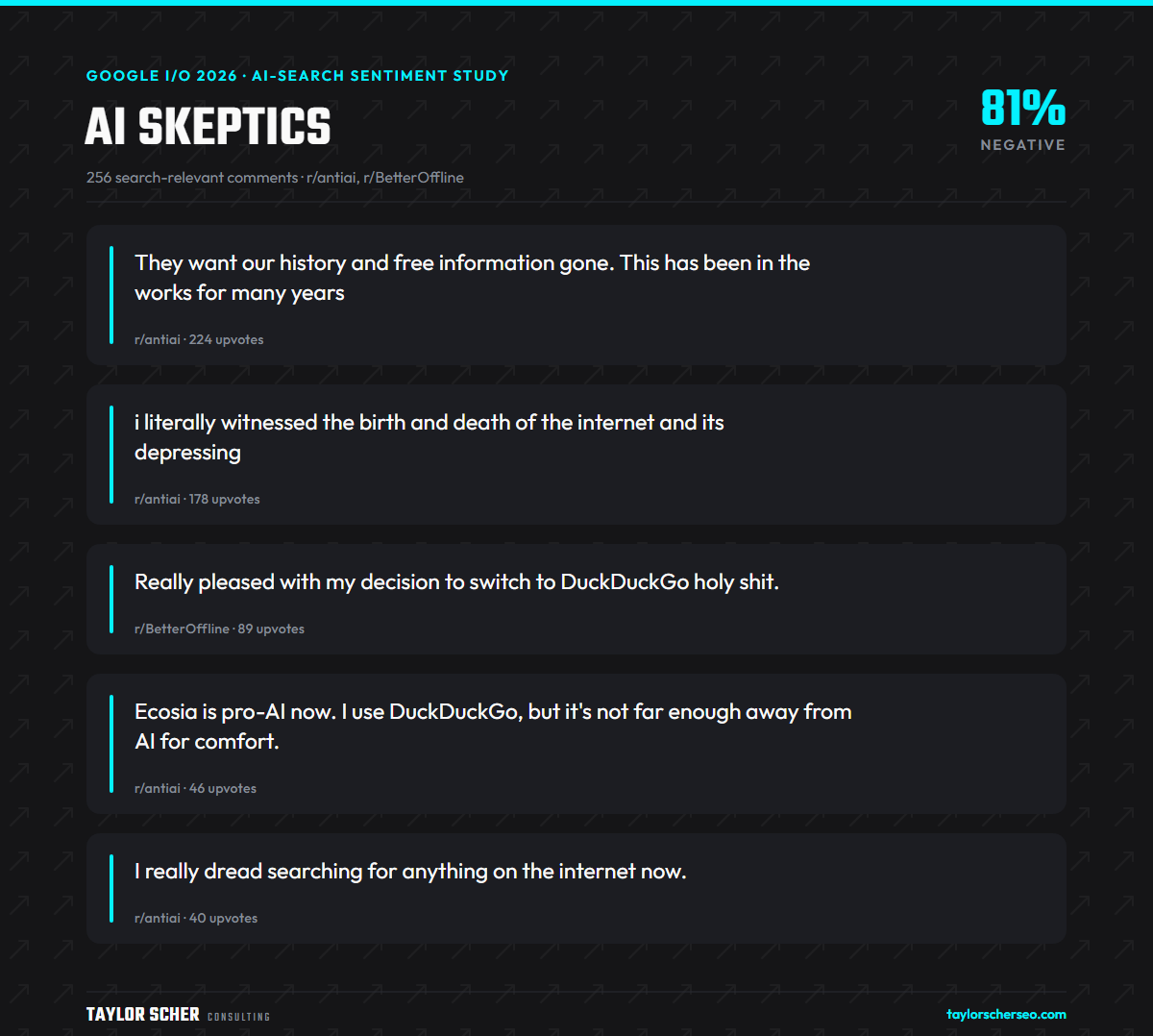
This group was also the quickest to head for the door, sometimes with a one-word verdict: "r/enshittification."
Mainstream, non-tech, 79%
This is the one I'd watch most, honestly, because these aren't tech people. They're general-interest communities, celebrity gossip, weird-news threads, and they came in nearly as negative as everyone else.
Their frustration was mostly with the UX and the feeling of having something forced on them. A Google exec's line about how people "want a mix of both" AI and the web got absolutely ratioed.
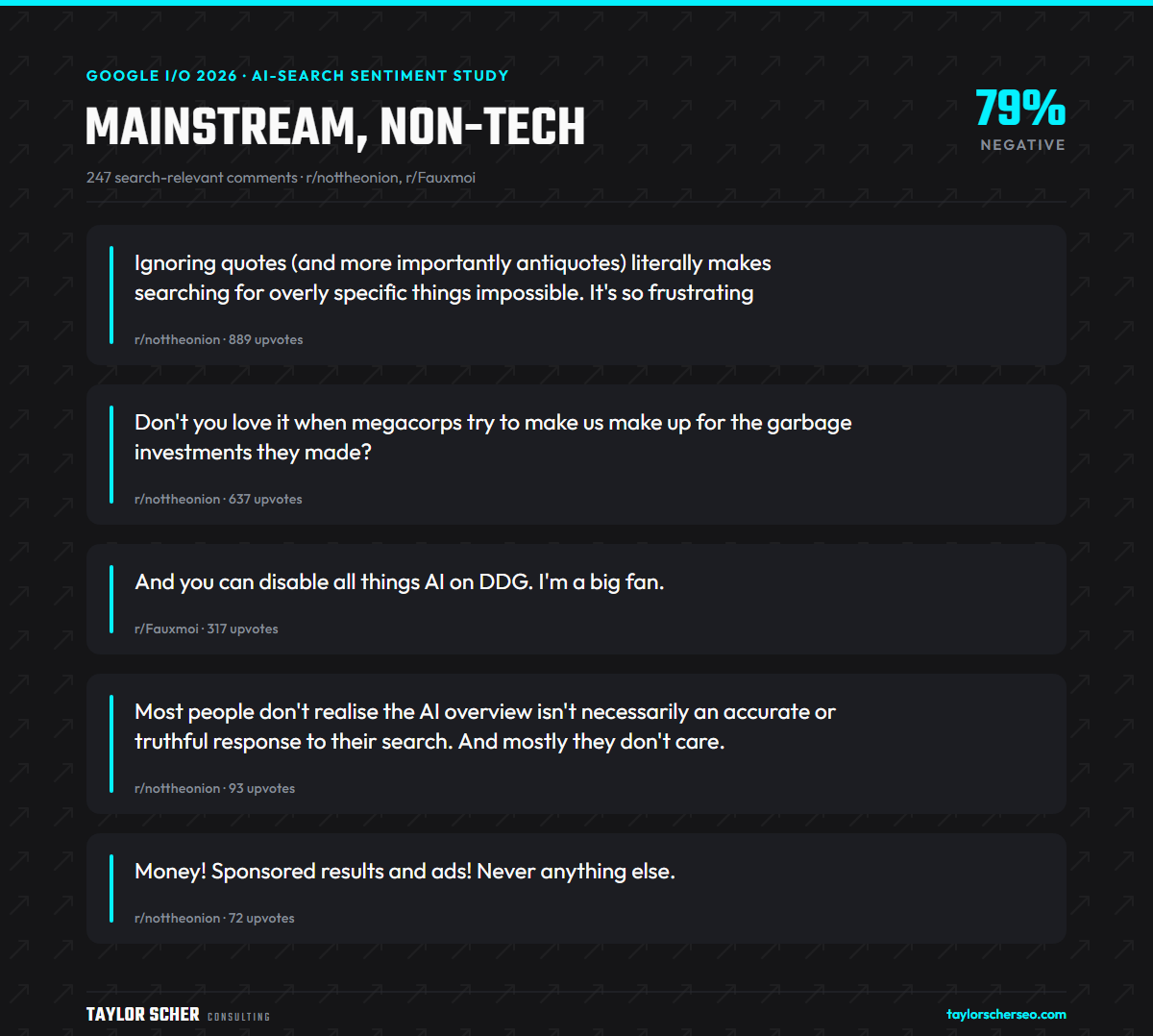
There was also real grief about losing precision via Quotes, minus operators, and other power-user tools people had built habits around:
"The first time Google ignored my quotation marks I felt like I had been literally slapped."
Neutral tech, 74%
The biggest and most detailed cohort, and the one that drove most of the dataset (almost 2,000 comments on its own).
Same accuracy core, but sharper and more structural. ChatGPT and Perplexity comparisons, antitrust talk, and a lot of "follow the ad money."
AI enthusiasts, 73%
Probably the most telling number in the whole set. These are people who like AI. They follow the models, they live in the OpenAI and Gemini subreddits, and they still landed 73% negative.
Their takes were a little more measured (several doubted people would actually switch), but the skepticism toward Google's execution was right there with everyone else's.
SEO / publishing, 52%
So this is the one that broke the pattern, and it's the part I find most interesting.
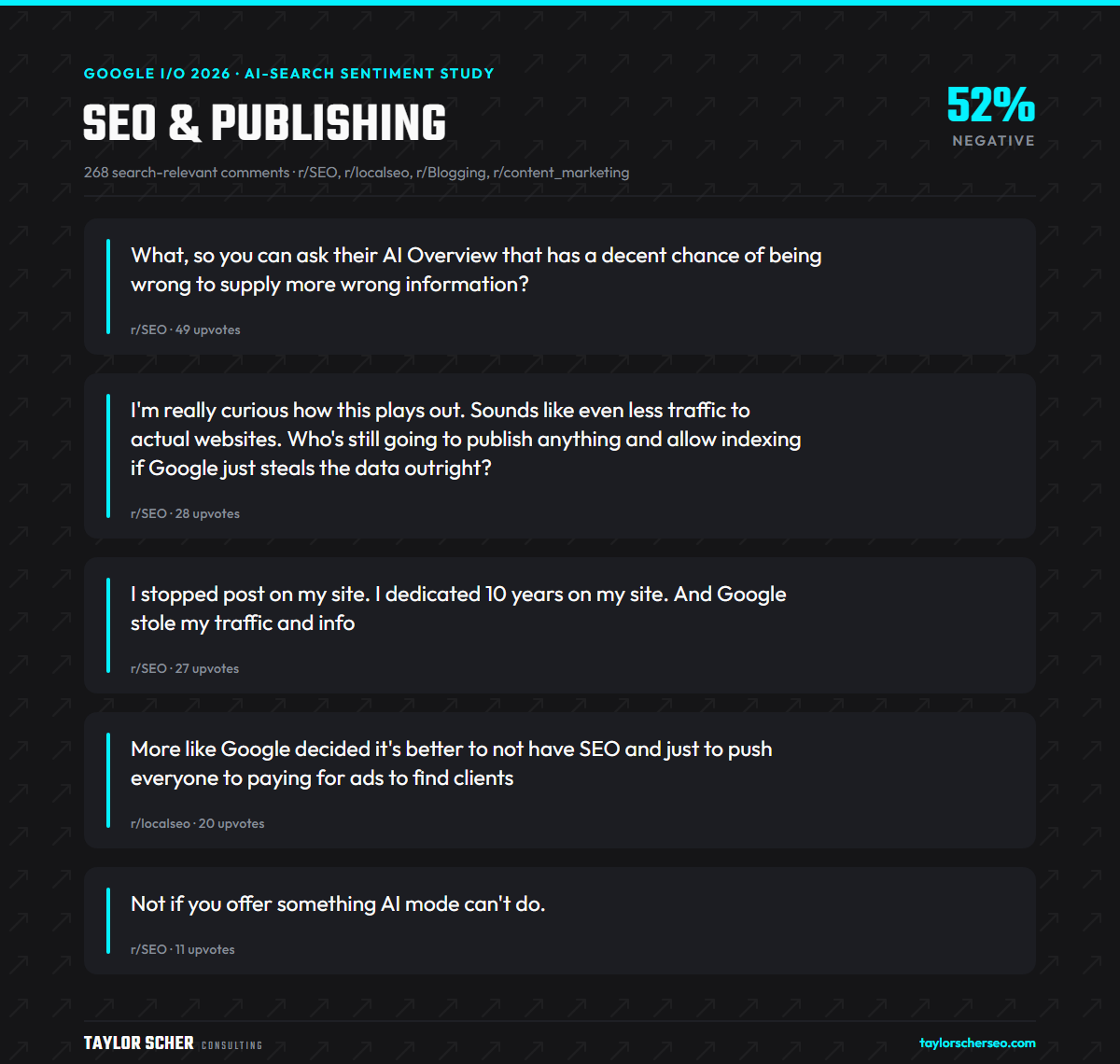
Every other audience clustered in that 73 to 84% band. SEOs and publishers came in at about 52% negative, with 41% landing neutral.
By far the calmest, most wait-and-see group in the study.
What stood out wasn't just that they were less negative. It's that they were worried about completely different things.
Accuracy, the thing everyone else obsessed over, barely registered here (39 mentions, against roughly 1,600 across the full set).
Their top concerns were the business stuff: what this does to the SEO industry, traffic loss, and whether the creator economy takes a hit.
To be fair, a majority of us have already been following these changes for years now.
"Honestly I don't think websites are 'cooked' but I do think low-effort SEO content is in trouble… strong brands, communities, tools, opinions, original research etc still matter because people eventually want a real source, not just an AI overview."
There was a real strain of "this is survivable if you're actually good:”
"People screaming SEO is dead are missing the technical reality. Under the hood it is a massive RAG system… How does it decide which 5 websites to feed into its context window out of 5 million? Domain authority and backlink graphs."
It wasn't all calm, to be clear. The affiliate and pure-traffic folks were genuinely rattled:
"Many sites are completely cooked… My job is likely gone in 6 months, working on the affiliate side. This is horrendous."
But the overall temperature was lower, and I think the reason is pretty simple: This group has been living with AI Overviews and AI Mode since around 2024.
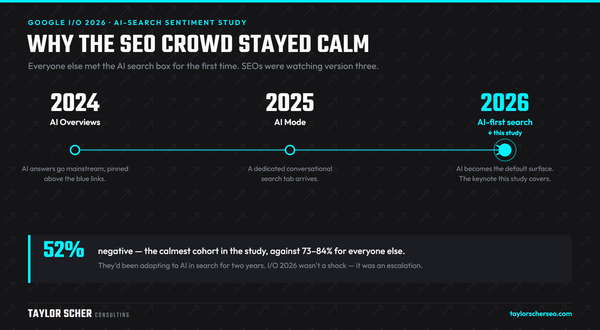
They've already watched click-through rates move and have already rebuilt strategies around it. I/O 2026 wasn't a shock to them.
If anything, we were expecting AI mode to be made the default search experience.
Could you imagine the public’s reaction to that change?
What I'd take from this
A few things I keep coming back to.
- This isn't an anti-AI mob, people just don’t want AI stuffed everywhere: The easy read is "people hate AI." But the AI-enthusiast cohort, the people most inclined to be excited about this stuff, still came in at 73% negative. When your single most sympathetic audience is this cold on it, the problem isn't AI in the abstract. They seemed more in favor of using existing LLMs like ChatGPT and Claude rather than an AI-heavy Google.
- DuckDuckGo is the next up option, not Bing. This is the part I think DuckDuckGo should heavily capitalize on. People see them as the next best option, especially for the ability to toggle off AI features. DuckDuckGo needs to be leaning into that HARD in their marketing.
- Accuracy is the main concern and understandably so. The dominant complaint across all audiences was "I can't trust what it tells me." That's an obvious problem for Google. It's also the most interesting tension in the dataset, because the same people who don't trust the AI summary are the ones who still want a real source to land on at the end. That trust gap is basically the whole ballgame for how this plays out, for Google and for anyone whose traffic depends on it.
- Watch the "wait and see" group, not the angry one. Out of every theme, only one wasn't soaked in negativity: feature curiosity, at 12% negative. That's the pool of people who genuinely haven't decided yet. If you want a leading indicator for where sentiment actually settles, it's not the loudest comments. It's whether that curious group quietly converts to "okay, this is useful" or drifts toward the exits everybody else was naming.
One last note, since I'd rather you trust the read than have me oversell it: This is a week-one snapshot, from two platforms that lean negative and online by nature. So take all of this with a grain of salt and wait for more usage numbers to come out.